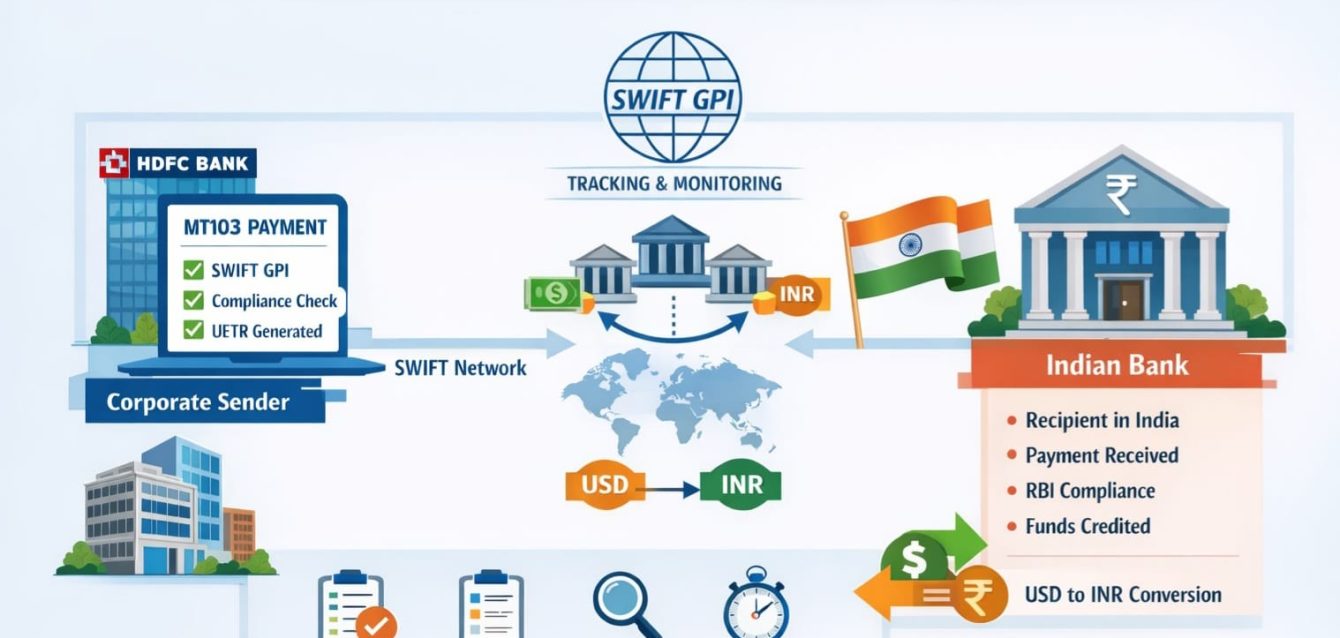
Cross-border payments into India, such as MT103 semi-automatic, require technical precision, regulatory awareness, and operational coordination between sending and receiving institutions, e.g., like RATNYXCYBER, which associates only in sending.
When executing a SWIFT MT103 under the SWIFT GPI (Global Payments Innovation) framework, the objective is not merely to transmit funds but also to maintain transparency, compliance with Reserve Bank of India (RBI) regulations, and efficient credit to the beneficiary account.
Majority sectors and individuals continuously research how to successfully execute the MT103/202 semi-automatic authorized by SWIFT GPI, and that is what this article will inform you on: how to structure and process a semi-automatic GPI payment to Indian banks, focusing on workflow, message construction, compliance, and settlement behavior.
Comprehending MT103 in the Indian
A single customer credit transfer message used in the SWIFT network is called an MT103. There are also other types of transfer messages used in SWIFT, such as MT202, MT300, MT320, and MT760.
On that note, when combined with SWIFT GPI, the payment gains end-to-end tracking via a unique end-to-end transaction reference (UETR).
For Indian remittances, MT103 is commonly used for:
- Settlements of trade
- Payments for consulting and services
- Inflows of investments
- Corporate transfers
- Repayment of loans
Indian banks process inbound SWIFT funds through their foreign exchange or inward remittance departments; if the payment is started abroad, it may go through correspondent banking systems even if the currency is INR.
You’d like to learn more how the SWIFT system is operated HERE IS IT.
Referring to semi-automatic, what does it mean
A semi-automatic payment occurs during the moment when a cross-border payment transaction reaches the destination bank but cannot be finalized by the system’s STP (straight-through processing).
Over 95% of the time this case happens, the system requires a few things: (1) a human trigger and (2) a non-GPI member
Human/Manual trigger;
Here, the sending bank’s system generates the MT103 automatically from structured payment input.
A member banking system oversees the incoming transaction that has just arrived within their system and goes ahead to make every adjustment that needs to be made before authorizing the transaction to the beneficiary’s bank for final clearing and settlement.
Non-GPI member;
If the transaction happens such that one member bank is not a GPI-enabled bank, the enabled institute will enforce the sequence of a unique end-to-end transaction reference (UETR) for digital train maintenance.
In many corporate setups, payment files are uploaded via host-to-host, SWIFT Alliance, or corporate Net-banking platforms (e.g., RATNYXCYBER). The system constructs the MT103 fields, but operations teams verify the following:
Beneficiary bank SWIFT/BIC accuracy
IFSC alignment
RBI purpose compliance
Sanctions screening results
Currency routing logic
Only after these checks does the payment enter the live SWIFT network.
Coordinate on your how to send a swift MT/MX cross-boarder payment,
Important information required for sending an MT103 Semi-Automatic GPI Payment to Indian Banks:
As instructed by the RBI when sending an MT103 semi-automatic GPI payment, pay attention to these details and make sure that they are correct and aligned with SWIFT.
:20: Transaction Reference
:23B: Operation Code (usually CRED)
:32A: Value Date, Currency, Amount
:50K: Ordering Customer
:57A: Account With Institution (Beneficiary Bank BIC)
:59: Beneficiary Customer
:70: Remittance Information
:71A: Charges (OUR/SHA/BEN)
:121: UETR (for GPI tracking)
Accurate beneficiary information is essential for Indian banks. The beneficiary account number and the core banking system must precisely match. Even little inconsistencies could lead to manual repair processing or money refunds.
If the remittance purpose is unclear, the beneficiary bank may request documentation before crediting the account. Therefore, Field :70: should contain a clear and compliant description, such as
“Consultancy Services Invoice 4589”
“Software Development Fees – Contract Ref 2026/04”
Final takeaway point:
The combination of SWIFT MT103 and GPI provides transparency and speed, but Indian inward remittance rules require careful attention to purpose codes, beneficiary accuracy, and compliance screening.
So when sending an MT103 Semi-Automatic GPI Payment to Indian banks, it is sorely less about just pressing send but more about structured message integrity, regulatory alignment, and operational discipline.
Call to action:
Based on the vast experience gathered from the number of years on this line, sending an MT/MX semi-automatic cross-border transfer to India or any other country has not been seamlessly easy as what is provided ELSEWHERE, WE ARE ONLY A TEXT/CALL AWAY.
Contact US:
Reach us through any of the easiest accessible networks in your region.
EMAIL: [email protected]
WHATSAPP: +34-460-22-62-90
TELEGRAM: RatnyxCyber